





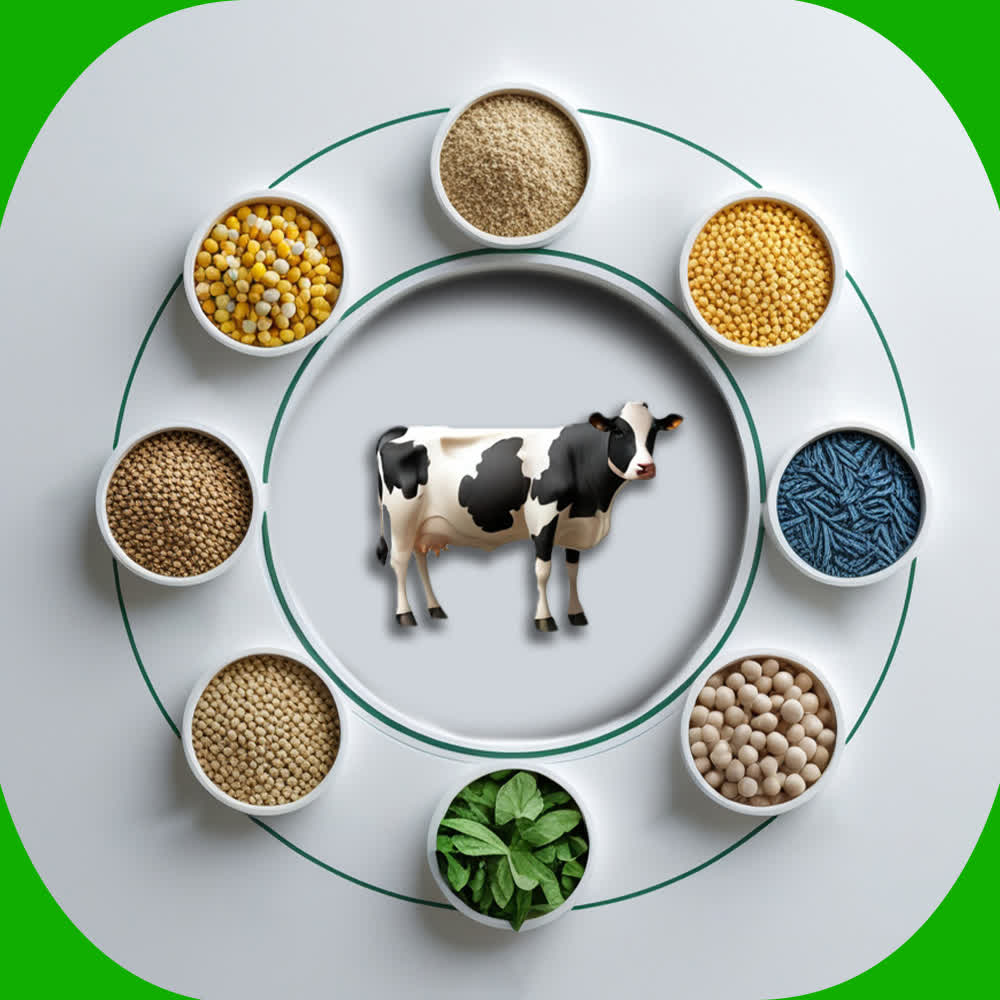
The livestock industry is the beating heart of food security in every country. Within this system, scientific and principled animal nutrition is undoubtedly the most critical link in the chain. Feed is the sole source that supplies animals with the nutrients required for growth, reproduction, health, and optimal economic performance. Scientific nutrition not only safeguards animal health but also has a direct impact on production profitability. A well-designed feeding program can reduce veterinary costs and maximize milk and meat production efficiency.
Definition of Livestock Feed and Its Main Components
Livestock feed refers to any substance that, when consumed by animals, can supply part of their nutritional requirements. These components include:
Energy (mainly from grains)
Protein (from oilseed meals)
Vitamins
Minerals
Fiber (from forages)
Classification of Raw Materials by Source and Function
Forages (Roughages)
Such as alfalfa, straw, and corn silage. These materials form a large portion of the ration and are the primary source of fiber.
Concentrates
Such as corn, barley, and soybean meal. This group supplies the energy and protein of the diet.
Grains as the Energy Base of the Diet
Corn, due to its high energy content; barley, because of its balanced energy and protein profile; and wheat, as a carbohydrate source, all serve as key dietary energy ingredients. The inclusion rate of each depends on price and availability.
Oilseed Meals: The Core of Protein Supply
Soybean meal is the highest-quality plant protein source due to its essential amino acid profile. Canola meal and sunflower meal are also suitable alternatives.
Vitamins: Key Micronutrients
Vitamins make up only a small fraction of the ration and total feed cost (2–3%). However, the absence or deficiency of even a single vitamin can pose serious risks to health, growth, and reproduction. When feed intake decreases, vitamin levels must be adjusted to maintain maximum production potential.
Key examples include:
Vitamin A: Vision, reproduction, and immunity
Vitamin D: Calcium and phosphorus absorption and bone health
Vitamin E: A powerful antioxidant protecting cells
B-complex vitamins: Energy metabolism
Minerals: Skeletal Health and Beyond
Calcium & Phosphorus: Bone structure, teeth, and milk production
Selenium & Zinc: Immune system support and fertility
Magnesium: Prevention of grass tetany in dairy cattle
The Role of Fiber in Ruminant Health
In ruminants such as cattle and sheep, fiber plays a vital role in stimulating digestive activity and improving rumen function. One of its most important benefits is the prevention of digestive disorders such as ruminal acidosis.
Fiber also improves feed efficiency. High-fiber feeds are bulkier and increase satiety, helping reduce excessive intake and enhance nutritional efficiency.
Formulation: The Science and Art of Combining Ingredients
Feed formulation, also known as ration formulation, considers age, weight, production goals, and physiological needs of animals. The objective is to create a cost-effective, palatable, and nutritionally balanced diet that promotes growth, health, and optimal productivity in livestock and poultry. Today, this process is performed using specialized software.
Grinding: Increasing Nutrient Availability
Grinding and size reduction increase the surface area of feed ingredients, improving enzyme access and digestibility. Proper understanding of grinding equipment can significantly reduce production costs and improve feed management in dairy and poultry farms. Many processing methods, such as grinding or rolling, can increase feed efficiency by 5–65%.
Excessive grinding, however, may be harmful for ruminants.
Mixing: Ensuring Uniform Intake
Accurate mixing ensures that every kilogram of feed contains a uniform distribution of nutrients. This prevents selective feeding and reduces the risk of deficiencies or toxicity.
Pelleting: Compaction for Greater Efficiency
During the pelleting process, physical and chemical changes are applied to feed ingredients to enhance nutritional value and support animal growth. Pelleting improves feed efficiency and reduces the need for excessive nutritional supplementation.
Pelleting is achieved through pressure and heat, offering several advantages:
Up to 15% reduction in feed wastage
Improved digestibility
Elimination of harmful bacteria such as Salmonella and E. coli
Probiotics: The Gut’s Defense Army
Probiotics are groups of live microorganisms used in animal nutrition. They are safe for animals and secrete enzymes that break down organic carbon chains, producing simpler sugars, alcohols, vitamins, and other beneficial nutrients. Probiotics will be discussed in greater detail in future articles.
Conclusion
With the advancement of animal sciences, feed preparation can no longer rely on past experience or guesswork. A balanced, scientific ration not only ensures animal health and prevents metabolic diseases but also directly affects the quantity and quality of final products—whether milk, meat, or other livestock products. Optimizing feed consumption improves feed conversion ratios and prevents financial waste, representing a major step toward the economic sustainability of livestock operations.
For professional consultation in animal nutrition and scientifically formulated rations, please contact the expert consultants at Atiyeh Dam Sepahan.

